The Empty Room
POND HOUSE
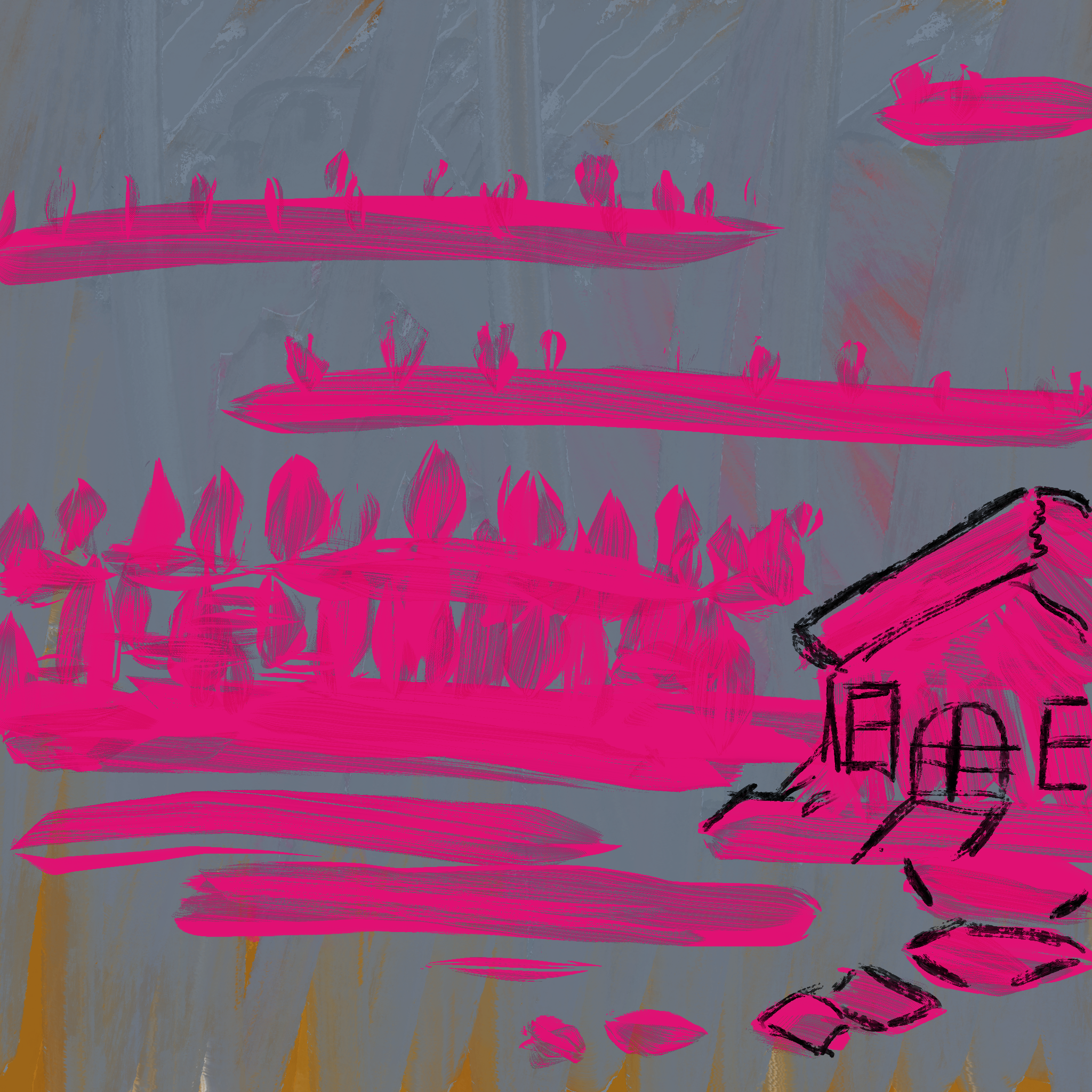
The lawn was empty. There was not much, but it was there.
Then the ground sunk in, it retreated, dispersed. To make way.
The lawn grew a foundation, if it was a good little capitalist lawn, it got a big basement.
The lawn grew walls. The studs appeared, then slowly the sheetrock, and then, poof, the roof.
Slowly the empty rooms were filled. We the builders were there, but soon forgotten.
But those walls remember. The floors hold dust, and dust remembers what it once was.
It was the lawn.
Imagine you're standing in an empty room.
Nothing on the walls, nothing on the floor.
Just you.
At first it feels like there's nothing here. But give it time. Slowly, you start to notice that the room isn't actually empty. Someone left something behind. Over there, in the corner, is something you didn't see when you walked in: a hanging piece of whatever, and it turns out to be exactly what you needed for the thing you were thinking about a few moments ago.
That's what I've started calling Empty Room Theory. There's something nice about an empty room, because there is always something to be found.
Empty Room theory is as follows:
Nothing is ever really empty,
An empty room asks you to slow down. When there's no physical matter or materials competing for your attention, you start to see what was always there: the light through the window, a scrap someone forgot, a shape you can build on. You create your reality slowly, one noticed thing at a time.
I see this in my own work. On a job site, a gutted room isn't a blank; it's studs, sheetrock and possibility waiting to be read. On the massage table, a body that seems "fine" still holds stories you only find by paying attention.
The room is you,
Here's the part that took me longest to see: the empty room is a picture of the inner life. Insight, real wisdom, can only be found within. That's why it's called in-sight.
We spend so much energy looking outward for answers. But when you clear the noise and sit with what feels like nothing, you start to find what was already waiting inside you. The answers were never missing. They were just in the corner you hadn't looked at yet.
Joseph Nguyen makes a similar point in Don't Believe Everything You Think: the wisdom we're searching for already exists within us, underneath our thinking.
Everything you need is already here,
The next time your life feels like an empty room, too quiet, too bare, not enough, try staying a little longer. Look in the corners. Someone, maybe a younger you, left something behind. There is always something to be found.
Bite-Sized Offering: A 5-Minute Empty Room Meditation
Sit somewhere quiet and close your eyes. Take three slow breaths.
Picture yourself standing in an empty room. Notice the walls, the floor, the light. Don't fill it with anything just yet.
Stay there. Let it feel empty for as long as it needs to.
Slowly let your attention wander the room. What's in the corner? On the windowsill? Hanging from the ceiling?
When something appears, don't judge it. Ask: what is this for? What was I just thinking about that this might answer?
Open your eyes and write down what you found, even if it's small.
If you'd like to go deeper, Pamela Eakins' "Meditation on Resurrection" in Kabbalah and Tarot of the Spirit pairs easily with this practice. Find the emptiness within, take in the void, then decorate how you wish.
Sources
Nguyen, Joseph. Don't Believe Everything You Think (2022)
Eakins, Pamela. Kabbalah and Tarot of the Spirit (Kindle edition)
Signing off, from the workbench
I am poetic by nature, but abrasive and transformative, like sandpaper. I've stopped apologizing for either half. Out here in the woods of upstate New York, between the job site and the treatment table, I keep finding the same truth in different materials: what's whole was never hidden very deep. It just needed some patient, honest friction to come through.
— Lulu